
VanSpot Finder travel guides
Motorhome electric hook-up: what to check before connecting to 230 V
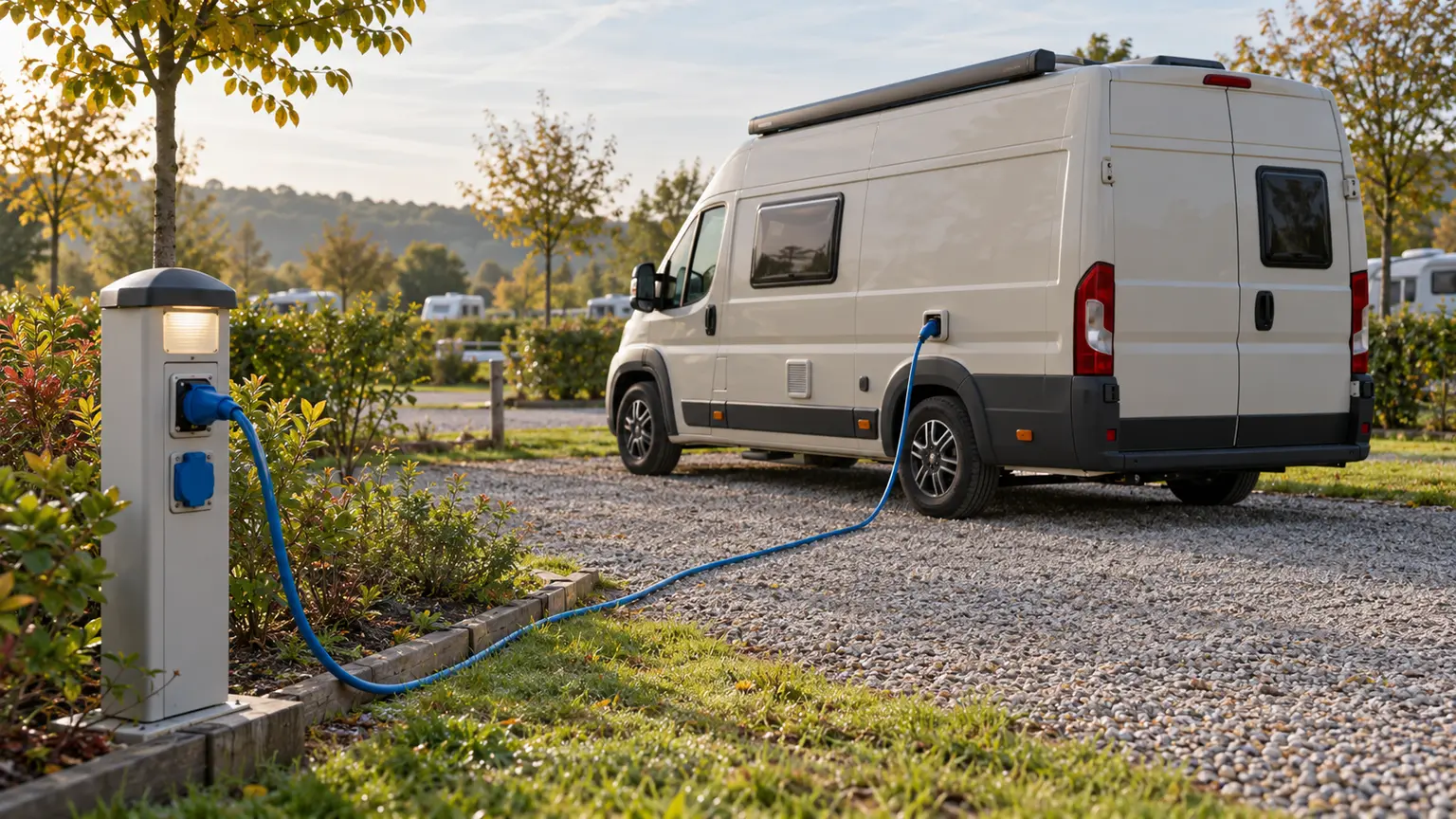
An electricity listing does not guarantee a usable hook-up
If your stop depends on a 230 V hook-up, check socket availability, compatibility, the permitted supply and access conditions separately. A campsite or motorhome aire may advertise electricity without guaranteeing a free bollard, inclusion in the pitch fee or access after reception closes.
This guide concerns connecting the habitation system to a supply intended for pitches. It does not cover charging an electric vehicle and does not replace the vehicle manual, site instructions or a qualified professional. When choosing the place itself, first check the type of overnight stop and its rules.
Questions to ask before making a detour
If electricity is essential for heating, medical equipment, work or charging the leisure battery, contact the site when its listing does not clearly answer these questions:
- Is a socket actually available for your pitch and dates?
- Is the hook-up included, charged separately, token-operated or limited to certain hours?
- Which connector is required, and does the operator allow the adapter you carry?
- What maximum current or power is available at the bollard?
- Can the cable reach without crossing a road or creating a trip hazard?
- What procedure applies if there is a fault, a trip or damaged equipment?
Check your equipment before connecting
Use only a cable and connectors intended for this purpose and compatible with the vehicle and site. Inspect the plugs and full cable length: a cut sheath, damaged pin, evidence of overheating or unusual moisture means the equipment should not be used. Changes to 12 V or 230 V circuits belong with a competent person.
- Switch off onboard appliances before connecting and follow the order given by the vehicle maker and site.
- Fully unwind the cable; do not leave a current-carrying length tightly coiled on a reel.
- Keep connections and electrical equipment dry and away from traffic areas.
- Test the residual-current device according to its instructions where the installation provides one.
- If you are unsure about earth, polarity, the bollard or the vehicle, do not connect and ask for help.
The touring organisations cited below also recommend switching off the supply before disconnection. Standards, plugs and procedures vary by country and site, so local instructions take precedence.
Connect, check and disconnect in a controlled order
The sequence below follows the Caravan and Motorhome Club procedure for its UK pitches. It does not replace the vehicle manual or the hook-up point instructions: if the site requires a different sequence or the equipment differs, follow its directions and ask for help before energising the supply.
A six-step sequence
- Switch off 230 V appliances and the vehicle isolator, then inspect the hook-up point, plugs and cable one last time.
- Fully uncoil the cable and route it away from traffic, without an improvised intermediate connection.
- Connect the vehicle end to the dedicated inlet first.
- Connect the site plug next, lock it or operate the control only as the site instructs, then switch the vehicle isolator on.
- Carry out the checks required by the manual and the site. Do not use the supply if a test reports reversed polarity or a fault remains unexplained.
- Before leaving, switch the vehicle isolator off, unplug from the site first and then from the vehicle; dry and store the cable without damaging it.
Fault or loss of power: decide before resetting
| Observed sign | Immediate action | Before restarting |
|---|---|---|
| Power trips after an appliance is added | Switch that appliance and non-essential loads off | Recalculate the load; ask the operator whether the pitch protection tripped |
| No power or an unexplained electrical fault | Keep the installation de-energised | Ask the operator or a qualified electrician; do not test by trial and error |
| Reversed polarity or an unfavourable safety check | Do not use the supply | Have the outlet and installation checked under local instructions |
| Damaged, wet, hot or unusually smelling cable, plug or outlet | Cut power without touching a hazardous part and move away | Report the defect; do not tape, join or reuse the equipment |
Power trips after an appliance is added
Immediate action : Switch that appliance and non-essential loads off
Before restarting : Recalculate the load; ask the operator whether the pitch protection tripped
No power or an unexplained electrical fault
Immediate action : Keep the installation de-energised
Before restarting : Ask the operator or a qualified electrician; do not test by trial and error
Reversed polarity or an unfavourable safety check
Immediate action : Do not use the supply
Before restarting : Have the outlet and installation checked under local instructions
Damaged, wet, hot or unusually smelling cable, plug or outlet
Immediate action : Cut power without touching a hazardous part and move away
Before restarting : Report the defect; do not tape, join or reuse the equipment
A trip is not permission to reset repeatedly. Switch appliances off, keep the installation de-energised while investigating and distinguish an identifiable overload from an unknown fault. Site staff can deal with the pitch outlet; a vehicle or cable fault needs a qualified person.
Work out your power budget before arrival
To turn an amp limit into a theoretical ceiling, use power (W) = voltage (V) × current (A). At 230 V, 5 A is about 1,150 W, 6 A is 1,380 W, 10 A is 2,300 W and 16 A is 3,680 W. This is not a target to reach: also respect the vehicle circuit limits, each appliance manual and the site instructions.
- Write down the current actually allocated to your pitch; do not infer it from an electricity icon alone.
- Record the input power shown on every appliance that may run at the same time, including the battery charger and refrigerator.
- Add only simultaneous loads and compare the result with the lowest ceiling: pitch outlet, vehicle circuit or manufacturer limit.
- Rank each use as an essential continuous load, a short high-power load or something that can wait. Switch one appliance off before starting another when the margin is too small.
Illustrative example: on a 6 A, 230 V hook-up, the theoretical ceiling is about 1,380 W. A charger rated at 300 W and a refrigerator rated at 135 W total 435 W; adding a 1,000 W appliance would bring the total to 1,435 W, above the ceiling. Delay that use, stop another load or choose a lower-power appliance. Always use the figures marked on your own equipment: the start-up input of some appliances, especially a microwave, can be higher than the advertised cooking output.
Stay within the available supply and respond safely to a trip
The bollard limit may be lower than several appliances require together. Heating, kettles, hobs, water heaters or hair dryers can overload the supply when used at the same time. Check their ratings and the site limit, then spread out their use.
- If protection trips, switch off appliances and find the cause instead of repeatedly resetting it.
- Report a damaged, hot, wet or unstable bollard to the operator.
- Do not improvise splitters, outdoor multi-sockets or a connection to an unauthorised outlet.
- Have the vehicle installation checked regularly in line with the manufacturer’s advice and by a qualified professional.
Without a confirmed hook-up, adapt consumption to the leisure battery and equipment actually installed. An inverter does not create energy: a 230 V appliance can draw heavily from the 12 V circuit. Choose another stop if the remaining autonomy cannot cover an essential need.
Plan the stop with VanSpot Finder
In VanSpot Finder, compare the services shown near possible spots and their distance. Identify one option with electricity and a backup before choosing the stop. A service shown in the app helps plan the route; it does not confirm in real time that a socket is free or working.
Note the address, arrival times, price and the operator’s reply. Also check vehicle access and where the bollard is located. To fit this stop into the journey without relying on one address, use our method to plan a campervan road trip.
Sources and limits of this guide
The connection advice, power calculation and consumption examples below come from British camping and electrical-safety organisations. They describe good practice, not a universal rule for every European country. Sources checked on 6 November 2026; follow the site rules, vehicle manual and local requirements for your trip.
Frequently asked questions about motorhome electric hook-ups
Does a pitch advertised with electricity guarantee a free socket?
No. The socket may serve only certain pitches, be fully booked, cost extra, have restricted hours or be temporarily out of service. Confirm it for your date and vehicle.
Can any extension lead be used for a hook-up?
No. Use a cable and connectors intended for the vehicle and site, in good condition and in line with the maker’s and operator’s instructions. Ask a qualified person if unsure.
What should you do if the breaker trips?
Switch off appliances, stop using the supply and identify the cause. Do not reset it repeatedly without understanding the fault; report it to the operator or have the installation checked.
How do you convert the hook-up amperage into available power?
At 230 V, multiply the stated amperage by 230 to obtain a theoretical ceiling in watts. Then add the input power of appliances used at the same time and also respect the limits of the vehicle circuits.
In what order should you connect and disconnect a motorhome from a 230 V hook-up?
When the manual and site confirm this procedure, first switch off appliances and the vehicle isolator, then connect the cable to the vehicle and to the site outlet. To leave, switch the isolator off, unplug from the site first and then from the vehicle. Local instructions and the manual always take priority.