
VanSpot Finder guides
All campervan and motorhome guides
Cleaning a motorhome water tank and water system
Plan six steps: identify equipment, drain, clean the tank, treat the pipes, rinse and check restart. Product choice, dose and contact time depend on the vehicle and product instructions.
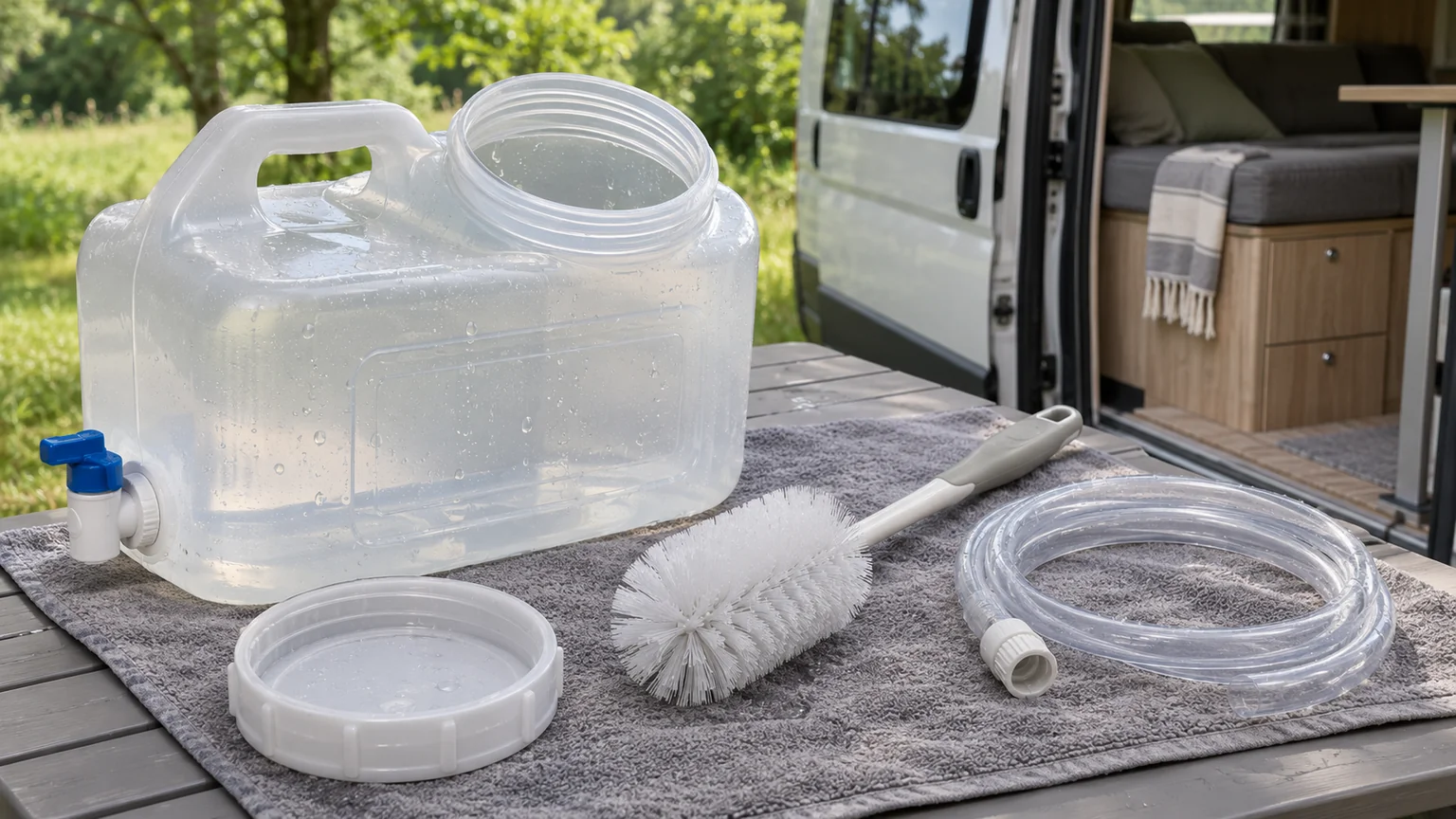
Clean the system using the vehicle’s procedure
Begin with the vehicle and equipment manuals, then select a product suitable for the intended use. The tank is only one part: pipes, pump, taps, filters and any water heater each have their own requirements.
This guide helps prepare the work and checks. It provides no universal bleach, vinegar or household-mixture recipe. Water without an odour or a visibly clean tank does not by itself establish that stored water is suitable for drinking.
Cleaning, rinsing and disinfection are different operations
Circulating detergent does not mean the system has been disinfected. Identify the purpose of each operation before choosing a procedure.
| Operation | Purpose | Instruction to identify |
|---|---|---|
| Cleaning | Remove deposits | Compatible method, soft tool and product |
| Rinsing | Remove product and residues | Drinking water and the prescribed rinsing procedure |
| Disinfection | Carry out a separate treatment where specified | Suitable product, concentration and contact time |
Cleaning
Purpose : Remove deposits
Instruction to identify : Compatible method, soft tool and product
Rinsing
Purpose : Remove product and residues
Instruction to identify : Drinking water and the prescribed rinsing procedure
Disinfection
Purpose : Carry out a separate treatment where specified
Instruction to identify : Suitable product, concentration and contact time
HYMER describes these operations separately and refers to product instructions. This is a manufacturer example, not a procedure automatically applicable to another vehicle. Set frequency using your own manual, system history and storage conditions.
Before starting: information and equipment
- Identify fresh-water tank, grey-water tank, drain, pump, water heater and any filters; record relevant model references.
- Read shutdown, draining and equipment-protection instructions before operating the pump or heater.
- Prepare drinking water for rinsing, dedicated cleaning equipment and a product explicitly compatible with the system.
- Check treated volume, dose, contact time, protective measures and permitted disposal in the product instructions.
- Choose a place where cleaning water can be disposed of correctly, without discharge onto the ground or into storm drains.
Keep sanitation equipment separate. Do not use a toilet-cassette brush or toilet-rinsing hose for fresh-water equipment. Use the waste-disposal guide to prepare a suitable disposal point.
Six steps for cleaning the tank and pipes
- Identify the system and put equipment into the prescribed state before intervention.
- Drain to a suitable facility using only the drain points permitted by the manual.
- Inspect the tank and remove accessible deposits with a soft tool only where permitted.
- Treat pipes with a compatible product at the specified dose and contact time. If disinfection is specified, follow its separate protocol and rinses; do not mix products.
- Dispose of solutions according to instructions and complete the final drinking-water rinse of affected branches.
- Check caps, connections, leaks and permitted restart; record the date, product and operations completed.
Filters and heaters can require special procedures: their presence does not mean every product is compatible. Do not operate equipment empty or in a state prohibited by its manual. Seek suitable assistance if the system cannot be identified or accessed.
Check restart and keep a record
Check closures, caps, fittings, absence of leaks and permitted operation at each outlet. Record date, product, volume, dose and the steps actually completed. If deposits, odour or uncertainty persist, do not use that water for drinking or cooking and have the system checked; a different fragrance or product is not a drinking-water test.
For the final refill, use a confirmed drinking-water point and clean equipment. If choosing or replacing storage, the water-tank capacity guide also helps you consider cleaning access.
Sources and verification date
Sources checked on 13 November 2026. Your vehicle and product instructions, the operator’s conditions and current local information remain decisive.
Frequently asked questions
Can I use any household cleaner?
No. Check compatibility with water intended for consumption and every affected component. Follow product and vehicle instructions and do not mix products.
Does cleaning the tank clean the whole system?
No. Relevant pipes, outlets and components must be included according to their instructions. Heaters and filters can have special requirements.
How often should I clean it?
Follow your manufacturer’s frequency and adapt restarting to the vehicle’s history and storage. An example from another brand does not create a universal rule.
Which product should I use to clean a fresh-water tank?
Choose a product intended for the task and compatible with affected tanks, pipes, seals, filters and any heater. Follow manufacturer instructions; an arbitrary household cleaner is not a universal solution.
How long should I leave the product to work?
Use the contact time specified for the product, its concentration and the affected system. This guide gives no universal duration; do not extend or strengthen treatment without instructions.