
VanSpot Finder guides
All campervan and motorhome guides
Campervan water tank: choosing between 20, 40 and 80 litres
The choice between 20, 40 and 80 litres depends on consumption and time between refills. Calculate the group’s requirement including a reserve, then compare it with usable volume and permitted weight. The examples below give illustrative requirements of 18, 24, 48 and 72 litres.
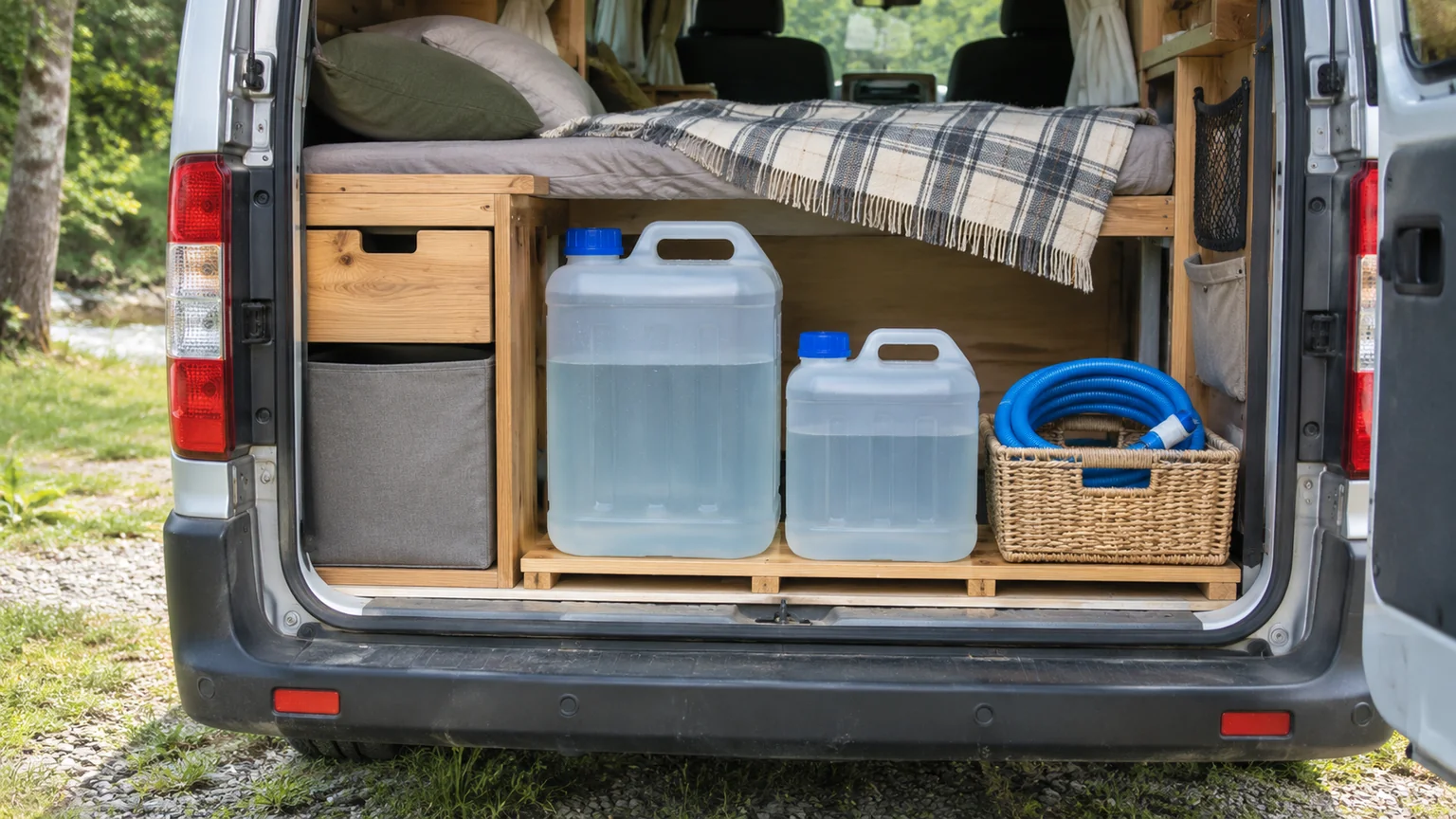
Capacity depends on use, not just the number of travellers
Choose capacity by estimating the group’s use between two confirmed refills, then adding a reserve suited to the route. An onboard shower, campsite facilities or cold meals can change the result substantially. There is no single volume suitable for everyone travelling alone or as a pair.
Distinguish nominal capacity, genuinely usable volume and any travelling fill limit in the vehicle manual. Include separately carried drinking water in the payload without counting it twice in your water balance.
Calculate before choosing the tank
- Measure litres used during a representative day, including the uses actually supplied by the tank.
- Multiply the group’s daily consumption by the days between refills.
- Add a reserve chosen for the route and available backups.
- Compare the requirement with usable capacity, available space and payload limits.
Required volume = group’s daily use × days between refills + reserve. To measure without relying on an inaccurate gauge, use the water-autonomy calculation. The next filling point must be accessible and confirmed, rather than simply shown on a map.
Illustrative examples for one and two people
The table assumes an arbitrary 6 litres per person per day for uses supplied by the tank. This is neither recommended consumption nor a measured average. Replace it with your own records and recalculate when adding a shower or other uses.
| Purely illustrative scenario | Calculation with chosen reserve | Calculated requirement |
|---|---|---|
| 1 person · 2 days | 1 × 6 × 2 + 6 litres | 18 usable litres |
| 1 person · 3 days | 1 × 6 × 3 + 6 litres | 24 usable litres |
| 2 people · 3 days | 2 × 6 × 3 + 12 litres | 48 usable litres |
| 2 people · 5 days | 2 × 6 × 5 + 12 litres | 72 usable litres |
1 person · 2 days
Calculation with chosen reserve : 1 × 6 × 2 + 6 litres
Calculated requirement : 18 usable litres
1 person · 3 days
Calculation with chosen reserve : 1 × 6 × 3 + 6 litres
Calculated requirement : 24 usable litres
2 people · 3 days
Calculation with chosen reserve : 2 × 6 × 3 + 12 litres
Calculated requirement : 48 usable litres
2 people · 5 days
Calculation with chosen reserve : 2 × 6 × 5 + 12 litres
Calculated requirement : 72 usable litres
Under these assumptions, a 20-litre canister cannot cover a 24-litre requirement, and a 40-litre tank cannot cover 48 litres. Check usable volume before selecting a marketed size. The grey-water tank or toilet cassette may require a service stop before fresh water runs out.
Comparing 20-, 40- and 80-litre capacities
This table revisits the four examples above. It assumes the stated capacity is fully usable and permitted in your configuration; check the manual. Weights cover water alone, excluding containers and fittings.
| Capacity compared | Approximate water weight | Reading this guide’s examples |
|---|---|---|
| 20 litres | 20 kg | Covers the 18-litre example, but not 24 litres |
| 40 litres | 40 kg | Covers 18 and 24 litres, but not 48 or 72 litres |
| 80 litres | 80 kg | Covers all four volumes if payload allows |
20 litres
Approximate water weight : 20 kg
Reading this guide’s examples : Covers the 18-litre example, but not 24 litres
40 litres
Approximate water weight : 40 kg
Reading this guide’s examples : Covers 18 and 24 litres, but not 48 or 72 litres
80 litres
Approximate water weight : 80 kg
Reading this guide’s examples : Covers all four volumes if payload allows
Then choose the physical format: several manageable canisters or a fixed tank with suitable cleaning access. If the volume exceeds available space or payload, shorten refill intervals or adjust uses; do not remove the reserve without reviewing the route.
Removable canisters or a fixed tank?
Canisters can be removed for filling and cleaning if they are manageable and properly secured. Several smaller containers can spread the lifting load, but use space and multiply caps and handling steps. Choose containers intended for water for consumption and easy to inspect.
A fixed tank can reduce routine lifting, but needs suitable positioning, supports, inspection and drainage. Its manual and a competent installer determine installation limits. Before buying, check cleaning access and how the system behaves in freezing weather.
Include weight and storage in the decision
As an approximation, one litre of water weighs one kilogram: 20, 40 and 80 litres mean roughly 20, 40 and 80 kg of water, plus containers, fittings and other loads. Check axle distribution too with the weight and payload guide.
Try handling the proposed format and storing it securely before choosing. A large, inaccessible supply may be impractical. Do not automatically travel at maximum fill: follow the prescribed travelling volume and match what you carry to confirmed refill opportunities.
Validate your choice on a short trip
On a nearby trip, record water carried, additions, remaining volume and the first service needed. Adjust capacity, habits or refill frequency afterwards. This is more reliable than a promised number of days for a given tank.
Use VanSpot Finder to identify a main point and a backup. Accessible services can reduce the volume you need, provided operation and conditions are confirmed. Plan tank and pipe maintenance too.
Sources and verification date
Sources checked on 13 November 2026. Your vehicle and product instructions, the operator’s conditions and current local information remain decisive.
Frequently asked questions
Is 20 litres enough for a campervan weekend?
In the one-person, two-day example, 1 × 6 × 2 + 6 = 18 litres, so 20 usable litres cover that calculation. This assumption does not replace your measurements, actual uses and route reserve.
Do two people need a larger tank?
At equal individual use, group consumption rises, but more frequent refills or accessible facilities can change the required volume. Measure real use.
Can I travel with every tank full?
Check prescribed travelling volumes, actual vehicle mass and axle limits. Fresh water, wastewater and their containers all form part of the payload.
Is a 40-litre water tank enough for two people?
Only if measured needs until the next refill, including reserve, fit within usable capacity. In this guide’s illustrative two-person, three-day scenario, the chosen requirement is 48 litres, so 40 litres does not cover it.