
Comfort on board
All campervan and motorhome guides
Condensation in a campervan or motorhome: how can you reduce it?
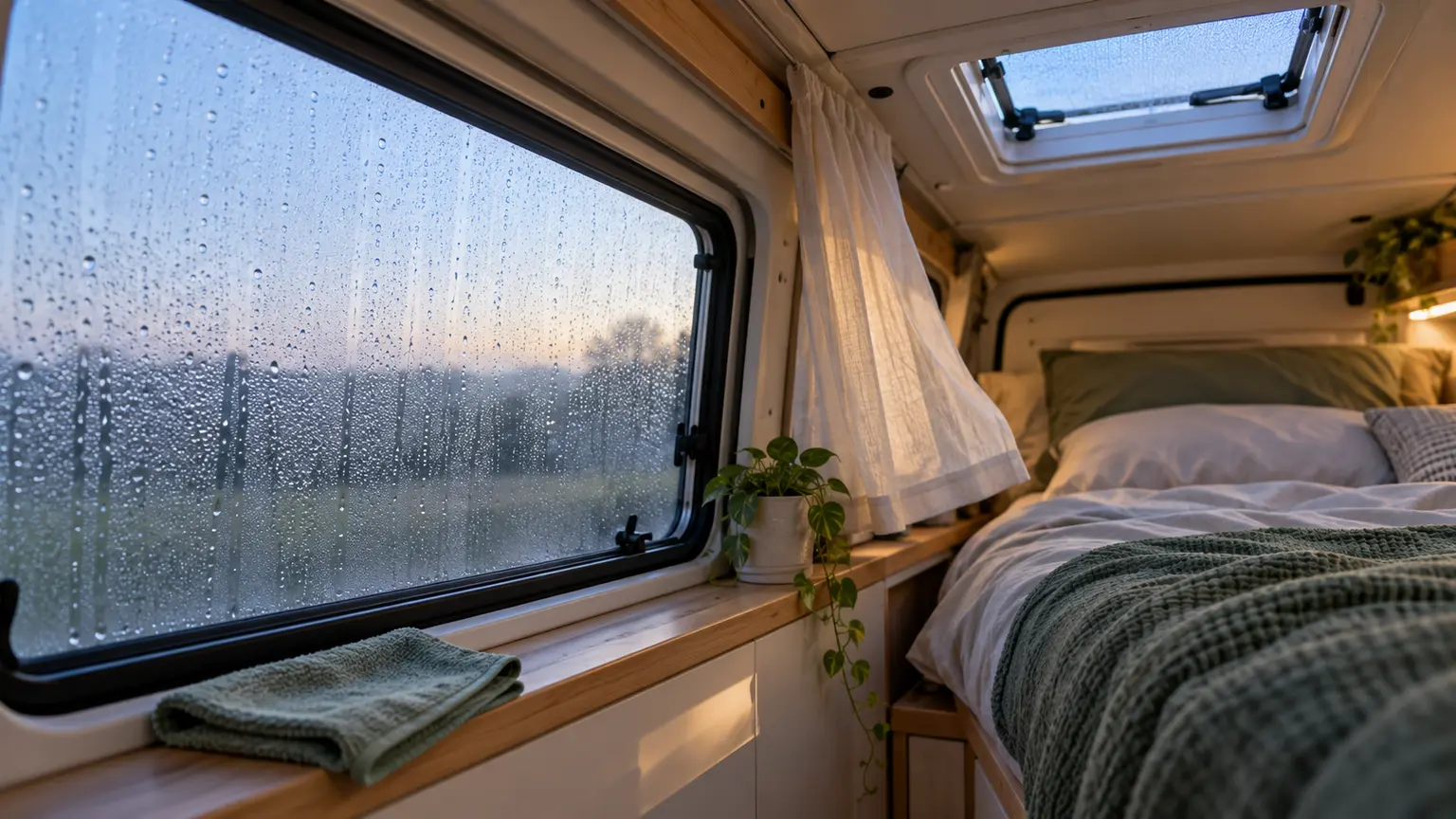
Why does water appear inside the campervan?
Condensation forms when warm, moist air meets a surface that is cold enough. In a small space, breathing, cooking, showering, wet shoes and drying clothes can quickly add water vapour. Windows and poorly ventilated areas cool first, so droplets may become visible there before moisture is noticed elsewhere.
The National Caravan Council notes that the effect is more common in winter, when surfaces are colder and windows and roof vents are opened less. A wet window in the morning is therefore not proof on its own that the vehicle is defective. It does show that the moisture produced needs a route out.
Condensation or water ingress: a four-step check
Dry the area completely first, then observe when the water returns. This check is not a substitute for a professional diagnosis, but it helps describe the problem without jumping to a conclusion.
- Record the exact location: the whole window, a roof corner, a seal, a wall behind furniture, beneath the mattress or one isolated point.
- Record the timing: after an occupied night, while cooking, after a shower, after rain or even while the vehicle is empty.
- Ventilate and dry, then compare another night in similar conditions. Widespread misting on cold surfaces after occupation often points to condensation.
- If moisture stays localised, returns after rain, stains wood or persists in an empty vehicle, have the seals, roof lights, cable entries and wall structure checked. Do not hide a suspected leak with a moisture absorber.
A routine before bed, during use and in the morning
The aim is not to make the vehicle airtight. It is to reduce moisture inputs and remove humid air without letting the whole living area cool unnecessarily.
- Before bed: keep wet clothes and shoes in a ventilated area or outside the sleeping space. Wipe up existing water and keep fixed vents clear.
- While cooking or showering: use the fitted extraction, crack a window or roof vent and keep steam as close to its source as possible. Do not dry laundry without an air outlet.
- Overnight: keep permanent ventilation unobstructed. If the windows start running with water, increase ventilation slightly in line with the vehicle manual and safe conditions.
- In the morning: briefly open two opposite points when possible, wipe the windows and dry the cloth. Lift the mattress and air lockers if their surfaces feel damp.
Let air move beneath the mattress and behind furniture
The main cabin may feel dry while moisture remains trapped beneath the bed, inside a locker or behind a backrest against an outside wall. The Camping and Caravanning Club highlights slatted bases and air gaps that allow circulation close to cold walls.
- Do not leave bedding, bags or cushions pressed against sheet metal or a cold outside wall.
- Check that air can pass beneath the mattress and that luggage is not covering intended holes or grilles.
- Open cupboards and lockers periodically after a damp night; move anything that blocks circulation.
- Dry the source first. Simply adding a mat or insulation over an already wet area can conceal the problem without drying it.
Heating helps, but it does not replace ventilation
Distributed heating reduces very cold surfaces, but the water remains in the air until it is removed. The useful combination is therefore to reduce vapour, heat with the intended equipment and ventilate. Never block fixed vents installed for safety, even if the draught feels uncomfortable.
Follow the vehicle and heater manuals. Never use the hob as a heater. If you rely on mains power, check the available load and permitted equipment in our guide to electric hook-ups for motorhomes.
Moisture absorber or dehumidifier: what can each do?
A moisture absorber may collect some water, particularly after use or during a short storage period, but it does not replace ventilation or investigating a leak. The NCC warns against expecting a lasting solution in a vehicle with permanent ventilation: once inside and outside humidity are similar, the product mainly keeps drawing moisture from ambient air.
An electric dehumidifier can be a supplement if its instructions allow the intended use, the power supply is suitable and collected water can be managed. It must not lead you to close safety vents. Judge its effect over several hours rather than from a full tank alone.
A three-night observation sheet
To avoid random adjustments, record a few simple observations over three nights. This method does not set a humidity standard; it compares your own conditions.
- Conditions: approximate outside temperature, rain or dry weather, number of occupants and time spent inside.
- Moisture inputs: cooking, showering, damp laundry or shoes, a wet pet and any visible water before bed.
- Ventilation and heating: openings used, vents kept clear and the heating mode intended by the manufacturer.
- Morning result: windows, underside of the mattress, cupboards and walls; distinguish “dry”, “light mist”, “droplets” and “localised damp patch”.
- Next action: change only one reasonable factor at a time, such as moving wet laundry out or increasing ventilation while cooking, then compare.
Plan the stop with VanSpot Finder
VanSpot Finder helps compare spots, car parks, service areas and campsites, together with nearby services and their distance. The app does not measure moisture inside the vehicle and does not guarantee that a service is working in real time.
If your routine depends on a shower, laundry, electric hook-up or heated building, identify several options and confirm opening times and conditions with the operator. For an off-season stop, also use the checklist for services open in winter and keep an alternative overnight stop.
Sources and limits of this guide
This guide is published by VanSpot Finder. It summarises technical guidance checked on 1 November 2026; it cannot diagnose water ingress, a heater fault or a health risk remotely. If the problem persists, arrange an inspection of the vehicle and its equipment.
Frequently asked questions about campervan condensation
Should you open the windows in cold weather?
Suitable ventilation lets moist air escape. Open windows or vents in line with the manual and conditions, and never block fixed safety ventilation. A short, effective airing in the morning can avoid prolonged cooling.
How can you prevent damp beneath the mattress?
Allow air to circulate beneath the bed, keep intended passages clear, lift the mattress after a damp night and dry visible water. A patch that remains wet despite these measures should be investigated.
Is a moisture absorber enough in a motorhome?
No. It may support drying in some situations, but it does not replace ventilation, control of vapour sources or investigation of water ingress.
Does water on a window mean the seal is leaking?
Not necessarily. A cold surface can condense moisture from inside. Damp that is localised, follows rain or persists when the vehicle is empty should be checked.
Can an app confirm that a stop will keep the campervan dry?
No. An app can help find and compare places and services, but ventilation, heating, weather and the condition of the vehicle still need to be checked.